Few areas of electrical terminology cause as much confusion as residual-current protection. Depending on where you live and which manufacturer's catalogue you're reading, you will meet RCDs, RCCBs, RCBOs, GFCIs, GFIs, ELCBs and — in post-Soviet countries — UZO and difavtomat. The good news: they describe a small family of devices with one shared idea. This article untangles the names and helps you understand which device does what.
The shared idea: detecting current that escapes the circuit
In a healthy circuit, the current flowing out on the live conductor equals the current returning on the neutral. If some current is missing, it is leaking somewhere it shouldn't be — through damaged insulation, through water, or through a person. Residual-current devices continuously compare outgoing and returning current and disconnect the supply within milliseconds when the imbalance crosses a threshold.
That speed is what makes these devices lifesavers: they can cut power before a shock becomes fatal. Safety bodies such as ESFI in the US and Electrical Safety First in the UK credit residual-current protection with major reductions in electrocution deaths.
RCD and RCCB — the European baseline
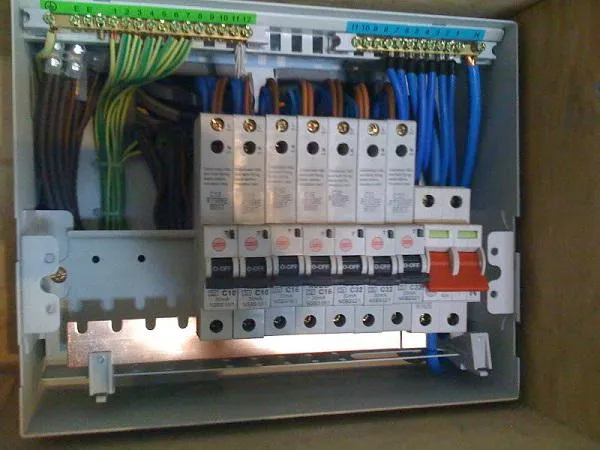
An RCD (residual current device) is the general European term. When the device is a standalone module in the consumer unit with no overcurrent protection of its own, it is technically an RCCB (residual current circuit breaker) — but electricians usually just say RCD.
- Devices rated around 30 mA are the common choice for protecting people.
- Higher-rated devices (100–300 mA) are used for fire protection and selectivity rather than personal protection.
- An RCD does not protect against overload or short circuit — it must be paired with circuit breakers.
We cover the internals in more detail in our guide to connecting an RCD or difavtomat.
RCBO — RCD and breaker in one
An RCBO (residual current breaker with overcurrent protection) combines residual-current detection with a normal circuit breaker's thermal and magnetic trips. One RCBO per circuit gives you the best of both worlds: an earth-leakage fault on the bathroom circuit trips only that circuit rather than half the house.
The Russian-language term difavtomat (дифавтомат) describes exactly this device, while UZO (УЗО) corresponds to a plain RCD. If you've read older articles on this site using those terms, RCBO and RCD are the international equivalents.
For how RCBOs relate to ordinary breakers, see our overview of circuit breaker types and functions.
GFCI — the North American cousin
A GFCI (ground fault circuit interrupter, sometimes just GFI) is the US and Canadian implementation of the same principle, built to North American standards. Practical differences worth knowing:
- Lower trip threshold. Personal-protection GFCIs are designed to trip at a few milliamps — noticeably more sensitive than the 30 mA European norm.
- Different form factors. GFCI protection often lives in the receptacle itself (the familiar outlet with TEST and RESET buttons) or in the breaker at the panel, rather than as a separate din-rail module.
- Test buttons matter. Like RCDs, GFCIs should be tested regularly using the built-in button.
ELCB — a term to retire
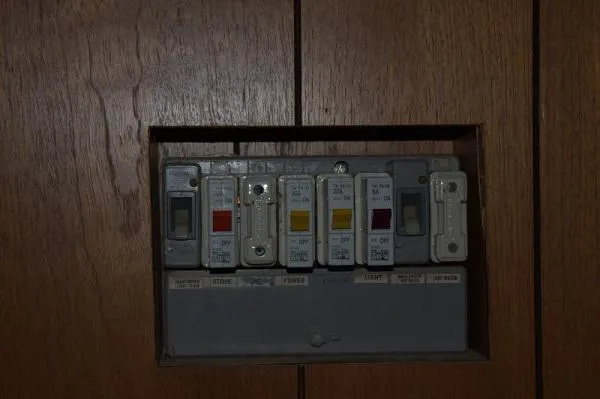
You may still hear ELCB (earth leakage circuit breaker), especially for older voltage-operated devices that detected a rise in earth potential rather than a current imbalance. Voltage-operated ELCBs are obsolete and have known blind spots; where one is still in service, that is a strong signal the installation deserves a professional inspection.
Quick comparison
| Device | Region / term origin | Detects leakage? | Detects overload/short? | Typical location |
|---|---|---|---|---|
| RCD / RCCB (UZO) | Europe, UK, AU and others | Yes | No | Consumer unit module |
| RCBO (difavtomat) | Europe, UK, AU and others | Yes | Yes | Consumer unit, one per circuit |
| GFCI / GFI | US, Canada | Yes | No (breaker types add it) | Receptacle or panel breaker |
| ELCB (voltage type) | legacy | Partially (obsolete method) | No | Old installations |
Which do you need?
That depends on your country's wiring regulations, the age of your installation and the circuits involved — bathrooms, kitchens, outdoor circuits and sockets likely to power portable equipment are the classic priority areas. Because requirements are jurisdiction-specific and change with each edition of the regulations, have a licensed electrician assess your installation rather than relying on a general article. What is universal: if your home has no residual-current protection at all, upgrading it is one of the highest-value safety improvements you can make.
Reminder: testing and replacing devices in a live panel is professional work. Use the TEST button monthly; leave everything past the cover to a qualified electrician.